

Project
Spiegel des Universums
A finished, live street-ritual platform — and the first product I built entirely through an AI-assisted development process.
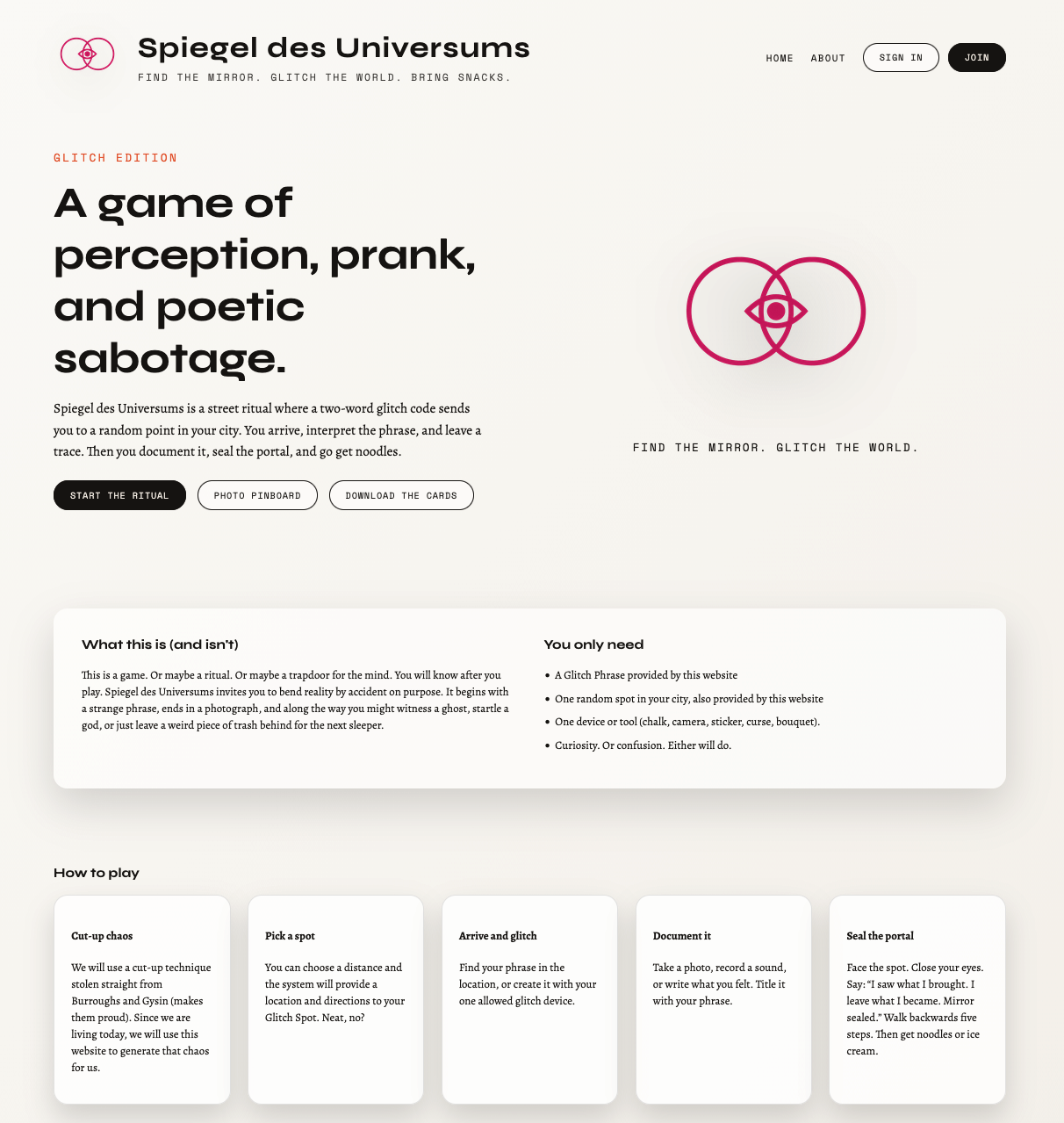
Spiegel des Universums is finished and live. It turns a strange street ritual into a working web application. Players receive a generated phrase and a location in their city, travel there, document what they find, and submit the result to a public ritual archive.
The project had to feel authored and atmospheric, but it also had to behave like a real product. Phrase generation, maps, uploads, member gating, public evidence, and downloadable artifacts all had to work as one system.
Where it changed
The first version stalled because the project existed only as drift, fragments, and conversational possibility. The breakthrough came when the work was forced into a bounded specification that separated what was decided from what was still open.
That handoff logic became the architecture. Once the constraints were explicit, the build moved fast: custom Ghost theme, geolocation rules, n8n orchestration, submission flow, gallery logic, and ritual downloads.
What shipped
The final system combines a Ghost site, a location-based mission mechanic, a member-gated submission route, a public pinboard, and downloadable ritual objects. The site is not a landing page about the idea. It is the idea, implemented.
What AI did — and did not do
AI is not part of the live product. The runtime is Ghost, geolocation, and member flows; submissions are handled by n8n workflows. AI was the development partner that made the build possible: helping turn an unusual concept into a bounded specification, architecture, theme, workflows, and a working product.
The value became especially concrete during play. GPS wayfinding had worked on Android, so an iOS-specific failure surfaced only when we were already playing on an iPhone. I opened the Codex app on the phone, fixed the problem within a few minutes, and we continued the game. AI shortened the repair loop; I remained responsible for diagnosing the real-world problem, choosing the fix, and checking that play could continue.
That is why the project matters as a case study. It shows that unusual, poetic briefs benefit from rigorous architecture even more than straightforward ones do — and that AI-assisted building can expand who is able to ship a technically coherent product without hiding where human authorship and responsibility remain.
Spiegel des Universums ist fertig und live. Es verwandelt ein seltsames Straßenritual in eine funktionierende Webanwendung. Spielende erhalten eine generierte Phrase und einen Ort in ihrer Stadt, gehen dorthin, dokumentieren, was sie finden, und reichen das Ergebnis in ein öffentliches Ritualarchiv ein.
Das Projekt sollte zugleich atmosphärisch und authored wirken, musste sich aber auch wie ein echtes Produkt verhalten. Phrasengenerator, Kartenlogik, Uploads, Member-Gating, öffentliche Evidenz und downloadbare Artefakte mussten als ein System funktionieren.
Wo es kippte
Die erste Version kam nicht voran, weil das Projekt nur aus Drift, Fragmenten und Gesprächsmaterial bestand. Der Durchbruch kam, als die Arbeit in eine begrenzte Spezifikation gezwungen wurde, die klar zwischen bereits Entschiedenem und noch Offenem trennte.
Genau diese Handoff-Logik wurde zur Architektur. Sobald die Grenzen explizit waren, ging der Build schnell: Custom-Ghost-Theme, Geolokationsregeln, n8n-Orchestrierung, Submission-Flow, Galerielogik und rituelle Downloads.
Was ausgeliefert wurde
Das fertige System verbindet eine Ghost-Site, eine ortsbasierte Missionsmechanik, einen member-gated Einreichungsweg, ein öffentliches Pinboard und downloadbare Ritualobjekte. Die Website ist keine Landingpage über die Idee. Sie ist die Idee, als Produkt gebaut.
Was KI getan hat — und was nicht
KI ist kein Teil des Live-Produkts. Zur Laufzeit arbeiten Ghost, Geolokation, Member-Flows, Einreichungen und n8n-Workflows. KI war der Entwicklungspartner, der den Build möglich machte: Sie half, ein ungewöhnliches Konzept in eine begrenzte Spezifikation, Architektur, Theme, Workflows und ein funktionierendes Produkt zu übersetzen.
Besonders konkret wurde der Wert beim Spielen. Das GPS-Wayfinding hatte auf Android funktioniert, deshalb zeigte sich ein iOS-spezifischer Fehler erst, als wir bereits auf einem iPhone spielten. Ich öffnete die Codex-App auf dem Telefon, behob das Problem innerhalb weniger Minuten und wir spielten weiter. KI verkürzte die Reparaturschleife; Diagnose des realen Problems, Auswahl des Fixes und Prüfung blieben in meiner Verantwortung.
Darum ist das Projekt als Fallstudie interessant. Es zeigt, dass ungewöhnliche, poetische Briefings noch stärker von sauberer Architektur profitieren als geradlinige — und dass KI-gestütztes Bauen erweitern kann, wer ein technisch kohärentes Produkt ausliefern kann, ohne menschliche Autorschaft und Verantwortung zu verschleiern.